


Can You Plant Trees in Summer in the UK

Quick Answer: Yes, container-grown trees can be planted throughout summer in the UK provided they are watered properly after planting. Unlike bare-root trees, which should be planted during the dormant season, potted trees can be planted at any time of year when soil conditions are suitable.
If you ask whether you can plant trees in summer, the short answer is yes — but only if you choose the right type of tree and give it the right aftercare. In the UK, the safest summer option is a container-grown tree. The RHS advises that container-grown trees and shrubs can be planted at any time of year, although autumn and winter are easier because less watering is needed. Bare-root and rootballed trees, by contrast, are seasonal and are generally planted in the dormant months.
That distinction matters. Summer planting is not impossible, but it is less forgiving. Young trees are most vulnerable in their first 12 to 36 months, and prolonged hot or dry weather can restrict growth, trigger leaf wilt or discolouration, and in severe cases cause tree death. Forest Research also notes that more frequent droughts and hotter summers make watering and mulching especially important after planting.
For Bowhayes customers, that makes summer a good time to buy potted, nursery-grown trees that are ready to plant now, provided you can water them properly through dry spells. If you are looking for a statement birch, a flowering cherry, a fruit tree or a screening evergreen, summer can still be a very workable planting window.

Can Container-Grown Trees Be Planted in Summer?
Yes, you can plant trees in summer in the UK, but this advice only really applies to container-grown trees. The RHS is clear that planting is generally best from October to April, and that you should avoid planting into frozen or waterlogged ground. However, container-grown plants can be planted at any time of year, including summer, as long as conditions are suitable and you are willing to take on the extra watering that summer planting requires.
The practical version of that advice is this: if the tree has an intact rootball in a pot and the soil is workable, summer planting is possible. If the tree is bare-root or rootballed and sold for dormant-season planting, wait until autumn or winter. Forest Research also highlights that consideration of planting season in relation to risks such as flooding or drought can increase survival, which is exactly why summer tree planting needs a more careful approach.
So the real question is not “Can I plant a tree in summer?” but “Can I plant this tree in summer, and can I look after it properly afterwards?” If the answer is yes, summer planting can work very well.
Which Trees Are Best for Summer Planting?
The best trees to plant in summer are container-grown trees that are already established in pots, rather than freshly lifted field-grown stock. They are used to having their roots held together in a contained rootball, which makes transplant shock easier to manage than with bare-root material. That is why summer promotions and nursery sales usually focus on potted stock rather than dormant-season stock.
The following categories are particularly well suited to summer planting when purchased as container-grown trees. Whether you're looking for blossom, fruit, screening or a compact tree for a smaller garden, these collections contain varieties available to plant now.

Flowering Trees
Cherries, magnolias, lilacs and redbuds for spectacular seasonal displays.


Container-grown vs bare-root trees
Bare-root trees are great value and often establish beautifully, but they are a dormant-season purchase. The RHS states that bare-root and rootballed trees are only available in autumn and winter, while container-grown trees are the flexible, all-year option.
That makes container-grown trees the natural answer for summer gardeners who want to plant now rather than wait for autumn. The trade-off is simple: you gain flexibility, but you take on more responsibility for watering, mulching and monitoring.
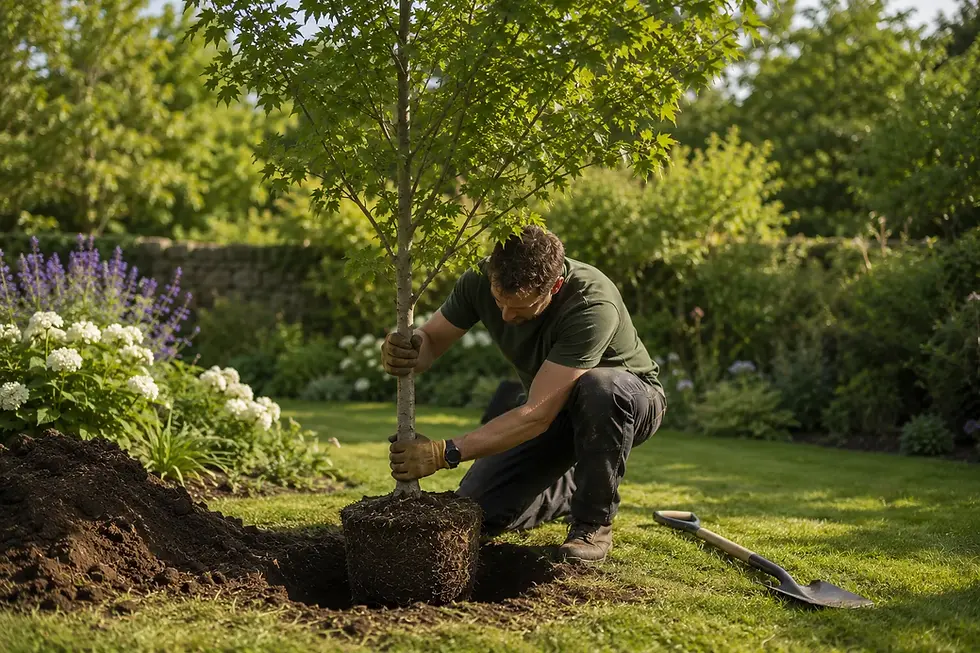
How to plant a tree in summer
Start by choosing the right planting day. Avoid periods of extreme heat, very dry windy weather, or baked ground that is difficult to re-wet. If possible, plant during a cooler spell or after rainfall, when the soil is easier to work and less moisture is lost immediately after planting. That recommendation follows the broader Forestry Commission and Forest Research message that establishment success improves when planting is matched to site conditions and drought risk.
Planting depth, staking and mulch
Prepare the site properly before the tree comes out of its pot. The RHS recommends loosening soil to roughly the depth of the rootball so roots can move into a better-aerated rooting environment. Avoid planting into waterlogged ground, but also be cautious of very dry, compacted soil, which can make establishment much harder in summer.
Dig a hole that allows the rootball to sit at the correct level. One of the most common mistakes is planting too deep. The root flare should finish at or just above surrounding soil level, not buried under backfill and mulch. Once the tree is in place, backfill firmly enough to remove large air pockets, but do not stamp the soil hard around the root zone.
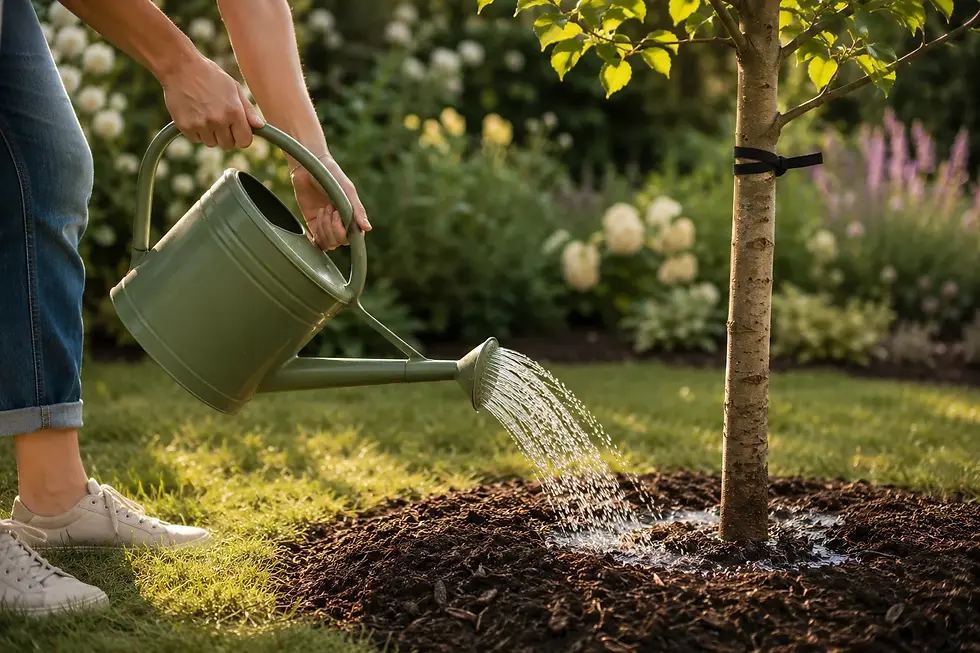
Water immediately after planting. The RHS advises watering slowly so that moisture reaches the rootball and the surrounding soil to a depth of around 20–30cm, where the roots are growing. This is much better than a quick splash at the surface, which often evaporates before doing any real good.
Staking is often worthwhile, particularly for anything larger than a very small young tree. RHS guidance explains that newly planted trees benefit from support because it reduces wind rock and root movement while the tree anchors itself. Most young trees do well with a single angled stake, while broader-crowned or more exposed trees may justify a double-stake system. The stake should support the tree, but still allow a little movement so the trunk can strengthen naturally.
Finish with mulch. Woodland Trust guidance recommends a mulch layer about 10cm deep and roughly 1m in diameter around each tree, keeping the mulch away from direct contact with the trunk. Mulch helps suppress weeds and slows evaporation, which makes a real difference during dry UK summers.
If you are planting in a lawn, create a clear circle around the tree rather than planting straight into grass and leaving it. Grass is a serious competitor for water and nutrients, and Forest Research lists weed control as a meaningful part of successful tree establishment.
Summer aftercare for newly planted trees
Aftercare is the part that decides whether summer planting succeeds. The Forestry Commission describes the first 12 to 36 months after planting as critical for young trees because this is when they are adapting to new site conditions and developing their root systems.
Watering in hot and dry weather
The RHS advises watering newly planted trees during dry spells from spring to autumn in their first year, and for large specimens for up to three summers. Water should go in slowly and deeply rather than little and often on the surface.
The Arboricultural Association goes further with a simple public-facing rule: newly planted trees should receive around 50 litres of water per week during the summer months, for the first three years after planting, with watering ideally done in the early morning or evening. That is a very useful benchmark for a Bowhayes reader because it turns vague aftercare into a practical routine.
Woodland Trust guidance is similarly clear for establishing young trees: in hot, dry weather, weekly watering is sensible, and keeping the base weed-free with mulch will help the soil hold moisture for longer. Their advice to keep weeds and long grass away from the base for the first two to three years is especially relevant for garden planting, where lawns often dry out ground more quickly than people realise.
This all means that summer tree planting is perfectly realistic if you can commit to a few basics:
Deep watering rather than frequent light watering.
Mulch to reduce evaporation.
A weed-free zone around the base.
Checking stakes, ties and guards as the tree settles in.
Watching for signs of stress such as wilting, scorched foliage or discolouration.
You do not need to overcomplicate it. Plant well, water properly, mulch generously, and keep competing growth away from the root area.
Best Trees Available to Plant Now
If you're looking to take advantage of the summer planting season, our current nursery stock includes flowering cherries, birches, maples, fruit trees and screening varieties that are available for immediate delivery or collection.
If you want a striking bark feature for a bright contemporary garden:
If you want a graceful blossom tree with strong ornamental appeal:
For edible planting:
For structure and privacy:
For future autumn impact:
FAQs about summer tree planting
Can you plant trees in hot weather?
It is better to avoid planting during extreme heat or prolonged drought. Summer planting is safest during cooler spells, on workable soil, and when you can water thoroughly afterwards. Young trees are especially vulnerable to prolonged dry conditions in their first 12 to 36 months.
Can you plant bare-root trees in summer?
No. Bare-root and rootballed trees are dormant-season planting options. If you want to plant in summer, choose a container-grown tree instead.
How often should I water a newly planted tree in summer?
The RHS recommends watering regularly during dry spells and making sure moisture reaches down into the root zone. The Arboricultural Association suggests around 50 litres per week in summer for the first three years as a practical guide.
Should I mulch a tree after planting?
Yes. Mulch helps conserve soil moisture and suppress weeds. Woodland Trust recommends around 10cm of mulch over a circle about 1m wide, keeping it clear of the trunk.
Do newly planted trees need staking?
Often, yes. The RHS advises that most young trees benefit from staking for the first few years, especially in exposed or windy sites, because it reduces root movement while the tree establishes.
What is the best time to plant trees in the UK?
For most trees, autumn to spring is still the easiest planting season, especially October to April. Summer planting is mainly for container-grown stock and requires more aftercare.
Can I plant a tree during a hosepipe ban?
In many areas, newly planted trees are exempt from hosepipe restrictions because watering is essential for establishment. Always check the guidance issued by your local water authority.
Ready to Plant?
Browse our Summer Sale collection to discover flowering cherries, birches, fruit trees, maples and screening varieties available for immediate delivery or collection.
To display the Widget on your site, open Blogs Products Upsell Settings Panel, then open the Dashboard & add Products to your Blog Posts. Within the Editor you will only see a preview of the Widget, the associated Products for this Post will display on your Live Site.
Start your 14 days Free Trial to activate products for more than one post.
icon above or open Settings panel.
Please click on the


Really useful breakdown — the "right tree, right aftercare" framing is exactly what's missing from most summer planting advice. The 50 litres per week benchmark from the Arboricultural Association is a great practical takeaway; it's surprising how many people assume a quick daily splash is enough when deep, slow watering is what actually reaches the rootball.
One thing I'd add from experience: planting in the evening during a cool, overcast spell (rather than a sunny morning) made a noticeable difference to how well my container-grown cherry handled its first summer. Also worth emphasising that mulch should never touch the trunk — I've seen more than a few trees suffer from collar rot because of well-meaning but overzealous mulching.
The point…